Counter Tops for White Cabinets: A Quick Guide to Getting the Pairing Right
Counter tops for white cabinets look best when their undertones, contrast level, and material fit the room as a whole. The quickest safe choice is usually a light gray or soft greige surface with subtle movement. It keeps the kitchen bright while adding enough definition to avoid an all-white, flat look.
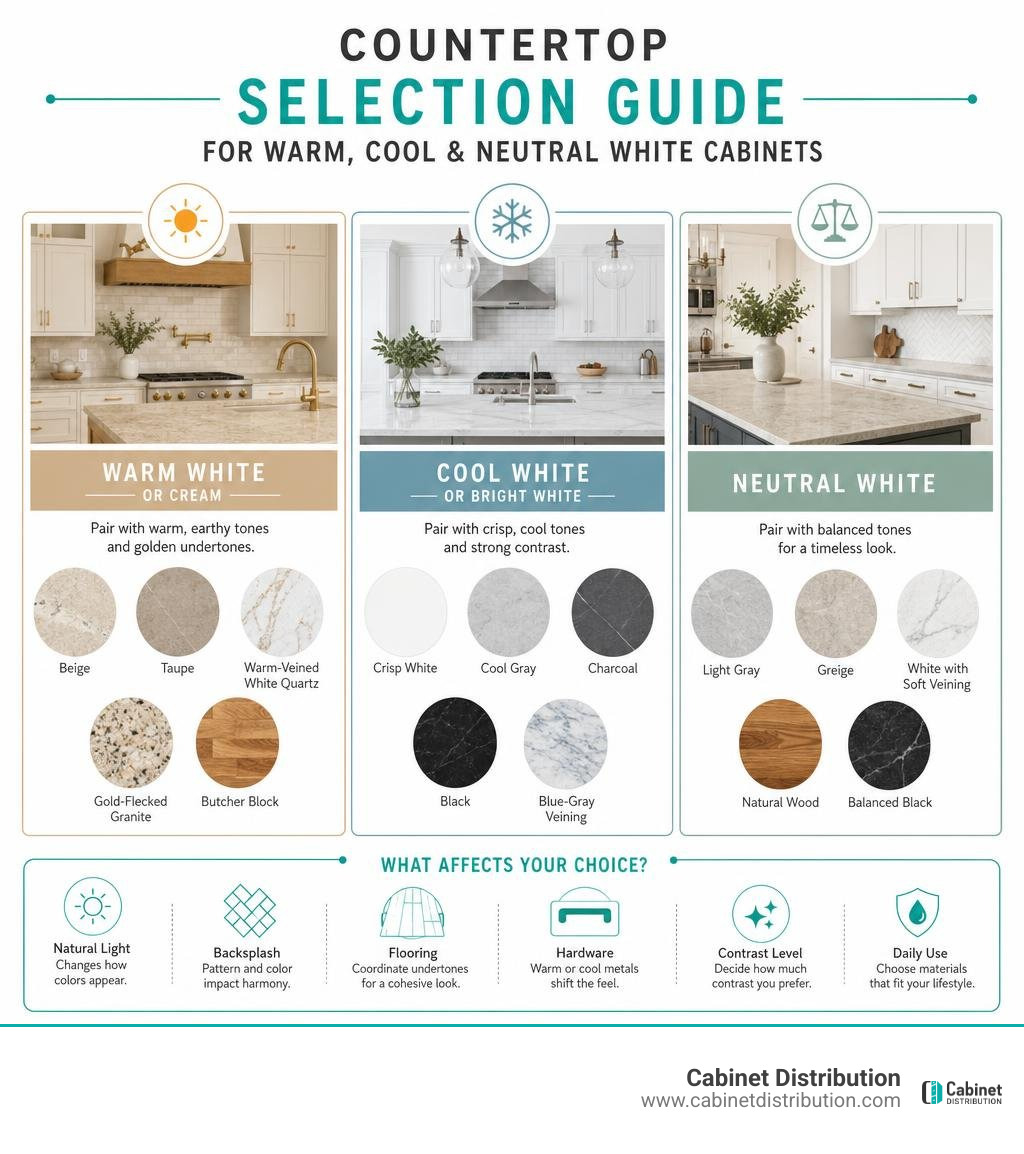
| If your cabinets are... |
Countertop directions that usually work well |
| Warm white or cream |
Beige, taupe, warm-veined white quartz, gold-flecked granite, butcher block |
| Cool or bright white |
Crisp white, cool gray, charcoal, black, blue-gray veining |
| Neutral white |
Light gray, greige, white with soft veining, natural wood, or balanced black |
White cabinets are flexible, but they also reflect nearby colors. That means a countertop can make the same cabinet doors look creamier, grayer, brighter, or more yellow than expected.
The right choice is not only about whether you prefer light or dark stone. Backsplash pattern, flooring, hardware, natural light, and your daily maintenance needs all matter. This guide will help you narrow down the color, contrast, and countertop material that suits your kitchen before you commit.
Determining Cabinet Undertones: Warm, Cool, and Neutral
Before picking a slab, you need to understand the true personality of your cabinetry. White is never just "plain white." Because white finishes reflect ambient light, they pick up and amplify the colors of adjacent countertops, walls, and flooring.
A simple way to check your cabinet undertone is the white printer paper test. Take a clean sheet of standard bright-white copy paper and hold it flat against your cabinet door in natural daylight.
- If the door looks slightly yellow, creamy, peach, or tan beside the paper, you have warm white cabinets.
- If the door appears crisp, icy, blue-toned, or stark gray, you are working with cool white cabinets.
- If the door matches the paper’s balance closely without pulling distinctly warm or cool, it is a neutral white.
Exploring the finest shades of white for kitchen cabinets helps clarify how subtle pigments transform under various lighting conditions.

Warm White Cabinets and Cream Palettes
Warm white cabinetry, such as pearl white, contains soft yellow, beige, or linen undertones that bring a welcoming feel to traditional, transitional, and cottage spaces.
When choosing counter tops for white cabinets with warm undertones, lean into surfaces that echo those subtle pigments:
- Warm-Veined Quartz or Marble: Look for slabs with delicate gold, taupe, or soft bronze veining.
- Warm Beige and Sandstones: Earthy neutrals blend naturally without creating a harsh divide.
- Natural Wood Accents: Walnut or butcher block surfaces highlight creamy cabinet finishes beautifully.
Avoid slabs with icy blue-gray undertones. Cool stone against creamy doors will make the cabinets read yellowed or aged by comparison.
Cool White Cabinets and Crisp Modern Profiles
Cool white cabinets, including styles like glacier white, feature pure, crisp, or faint blue-gray undertones. They create a clean canvas favored in modern, minimalist, and contemporary homes.
For these bright surfaces, pair with:
- Cool Gray Quartz or Granite: Slabs with slate, ash, or charcoal flecks provide crisp definition.
- High-Contrast Black Slabs: Honed jet black or deep graphite creates a sharp modern profile.
- True Carrara-Style Veining: Fine, cool gray ribbons across a pure white base enhance the cabinetry's clean lines.
Steer clear of muddy beiges or yellow-gold veins, which can look mismatched against icy white doors.
Neutral Whites and Flexible Foundations
Neutral white doors offer a balanced foundation without strong yellow or blue pigments. A classic white shaker door profile in a true neutral white provides maximum design versatility.
Neutral white pairs effortlessly with:
- Warm or cool veining patterns.
- Soft greige composites that merge gray and beige.
- Striking dark stone, rich butcher block, or subtle tone-on-tone light quartz.
The Best Color Counter Tops for White Cabinets
Selecting the right color palette establishes the mood of your kitchen. Browsing stylish and elegant white kitchen cabinet ideas reveals how varying stone tones create distinct kitchen styles.
Low-Contrast and Light Counter Tops for White Cabinets
A low-contrast layout pairs white cabinetry with light countertops to create an airy, seamless, gallery-like feel. This approach helps smaller kitchens feel open and expansive by allowing light to bounce freely across horizontal and vertical surfaces.
Key directions for light surfaces include:
- Subtle Gray Movement: Engineered quartz with faint, feather-soft veining provides dimension without overwhelming the room.
- Calacatta-Inspired Patterns: Broader, sweeping gray or gold veining adds movement to a clean white field.
- Solid or Muted Off-Whites: Fine speckled whites or uniform composites offer a minimalist look.
Design tip: To avoid a sterile feel, pair light-on-light surfaces with warm hardware (such as brushed brass or champagne bronze) and textured backsplashes.
High-Contrast and Dark Counter Tops for White Cabinets
Dark countertops ground a kitchen, anchoring the base cabinetry and creating a striking, graphic statement.
Popular high-contrast pairings include:
- Honed Jet Mist Granite: Offers the soft, subtle white dusting of soapstone with the durability of granite.
- Deep Charcoal and Slate Quartz: Delivers high contrast that is slightly softer than jet black.
- Matte Black Slabs: Creates a modern, architectural presence.
Opting for a honed, leathered, or matte finish on dark stone softens glare, reduces visible fingerprints, and hides water spots better than high-gloss polished surfaces.
Warm Wood, Butcher Block, and Mid-Tone Neutrals
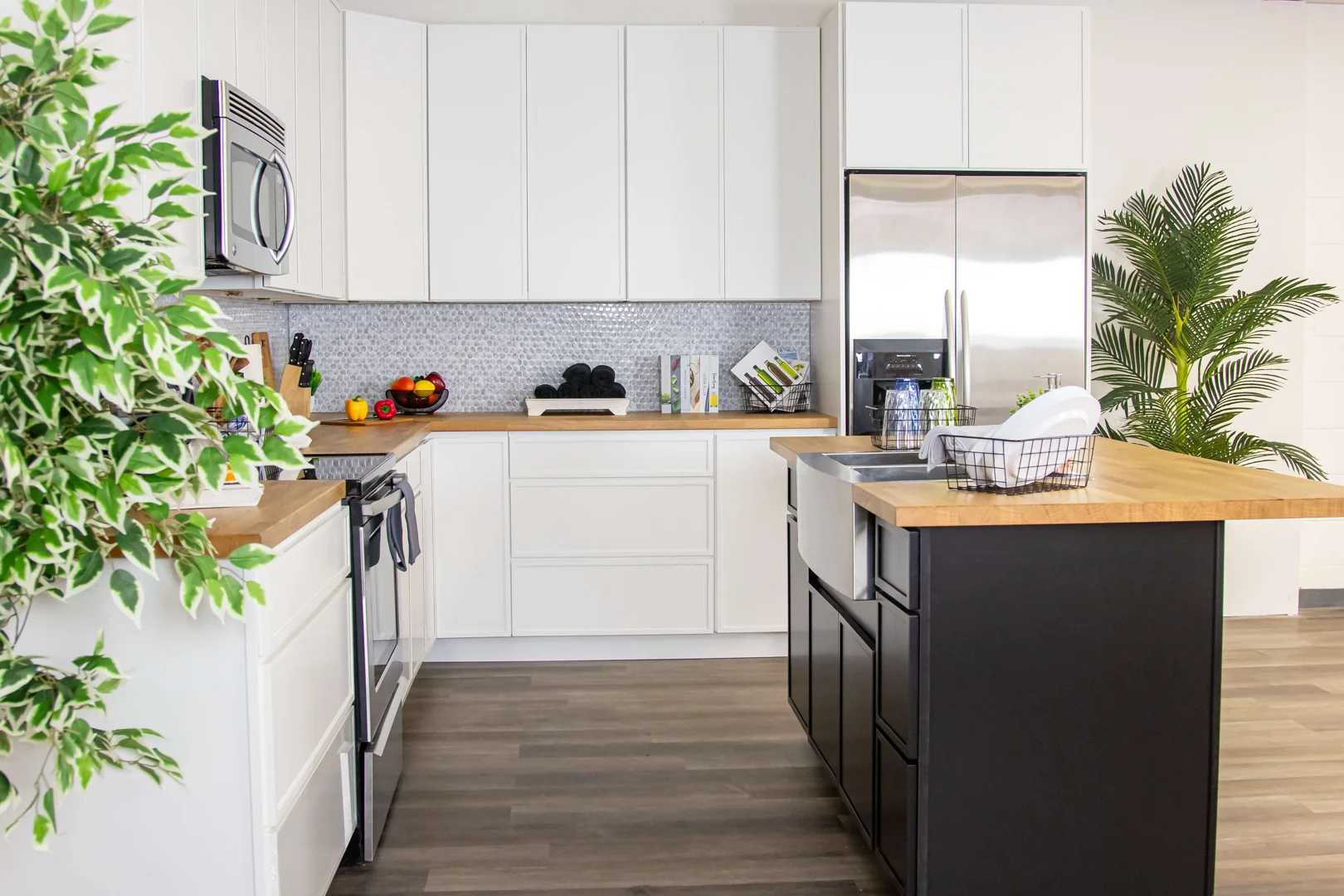
If stark black or pure white feels too extreme, mid-tone neutrals and natural wood surfaces offer an inviting middle ground:
- Butcher Block: Edge-grain maple, walnut, or oak counters instantly add organic warmth and texture to painted white cabinetry.
- Soft Greige and Concrete Tones: Neutral composite surfaces bring an earthy, relaxed, or industrial character to the space.
- Speckled Earth Tones: Subtle composites featuring sand, taupe, and river-rock hues blend well with natural wood accents and hardwood flooring.
Countertop Materials Compared: Quartz, Granite, Marble, and Butcher Block
Choosing the right material ensures your countertops handle daily meal prep, spills, and cooking heat effortlessly.
| Material |
MOHS Hardness |
Porosity & Sealing Needs |
Heat Resistance |
Best Design Pairing |
| Engineered Quartz |
7 (Very High) |
Non-porous; never needs sealing |
Low (Resin softens around 300°F; use trivets) |
Modern, transitional, low-maintenance living |
| Natural Granite |
6 to 7 (High) |
Low to medium; annual sealing recommended |
High (Withstands hot pots well) |
High-traffic family kitchens, busy cooks |
| Quartzite |
7 (Very High) |
Low; requires periodic sealing |
Very High (Naturally durable stone) |
Dramatic luxury islands, active kitchens |
| Natural Marble |
3 to 4 (Soft) |
High; prone to acid etching & staining |
Moderate |
Baking stations, classic heritage spaces |
| Butcher Block |
2 to 3 (Soft) |
Porous; monthly mineral oil application |
Low (Scorches easily; requires hot pads) |
Rustic, Scandinavian, and warm accents |
Engineered Quartz and Sintered Stone
Engineered quartz remains one of the most requested surfaces in residential remodeling. Made from crushed natural quartz bound with polymer resins, it creates an ultra-durable, non-porous slab that resists stains, acids, and scratches.
With a Mohs hardness scale rating of 7, quartz outperforms softer stones in scratch resistance. Because it never requires periodic sealing, it is an exceptionally low-maintenance partner for busy kitchens. However, the resin matrix can be damaged by sudden thermal shock at temperatures around 300°F, so hot trivets are essential.
Natural Granite, Quartzite, and Marble
Natural stone brings organic depth, veining, and unique geological variations to your kitchen:
- Granite: Slabs like Brazilian White Ice granite blend white and gold fields with dramatic veins of chocolate and charcoal. Granite provides excellent heat and scratch resistance when sealed regularly.
- Quartzite: Slabs such as White Diamond quartzite combine the elegant, crystalline look of marble with the exceptional hardness and acid resistance of quartz.
- Marble: Famous varieties like Calacatta Macchia Vecchia provide unmistakable luxury. Marble is softer (MOHS 3 to 4) and porous, requiring careful maintenance to manage etching from citrus, wine, and oils.
Coordinating Countertops with Backsplash, Flooring, and Kitchen Lighting
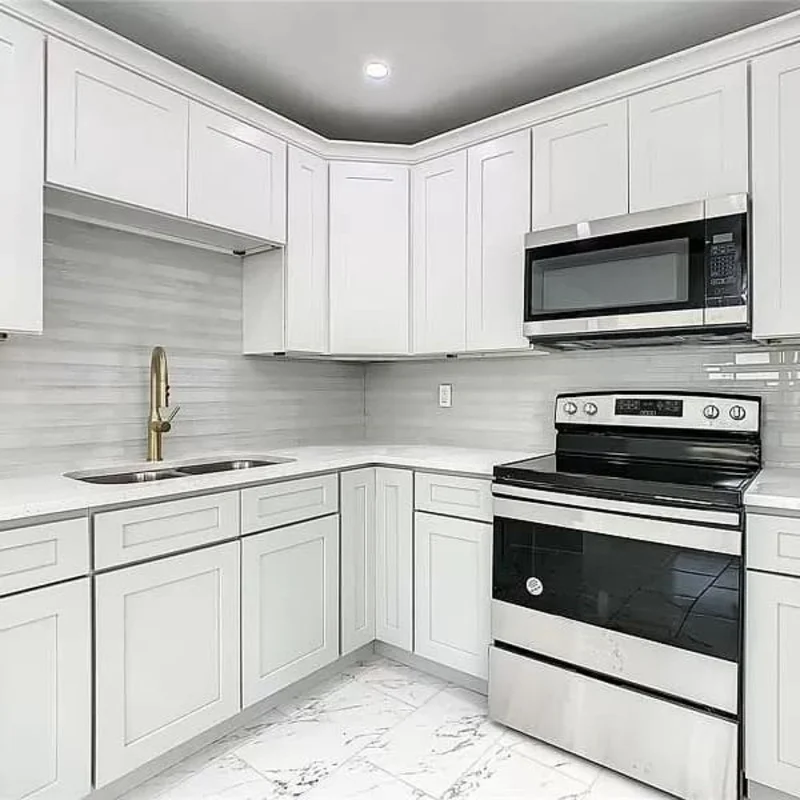
A beautiful kitchen relies on a clear visual hierarchy. Your countertops, backsplash, flooring, and lighting should complement one another rather than fight for attention.
Backsplash and Flooring Harmony
When planning surfaces, use the rule of focal points:
- Bold Countertop, Quiet Backsplash: If your countertop features dramatic, wide veining (like Calacatta quartz or exotic granite), pair it with a subtle, neutral backsplash such as classic subway tile or a solid field tile.
- Simple Countertop, Textured Backsplash: If your countertop is uniform (solid light gray or pure white), introduce visual texture with handmade zellige tile, a herringbone layout, or a contrasting focal backsplash.
- Full-Height Slab Splash: Extending your countertop material up the wall creates a clean, continuous look that highlights stone veining.
Flooring grounds the design. Warm hardwood or wood-look tile balances cool white cabinets and light stone. If your flooring features bold stone patterns, keep the countertops understated to avoid visual clutter. For more layout and pairing inspiration, check out these white shaker cabinets ideas.
Kitchen Lighting and Color Temperatures
The color temperature of your lighting fundamentally alters how white cabinets and countertops appear. Lighting is measured on the Kelvin (K) scale:
- 2700K – 3000K (Warm White): Creates an inviting glow, but can make creamy cabinets look yellow and cool gray counters look muddy.
- 3500K (Neutral White): Provides a clean, balanced light that renders both warm and cool materials accurately.
- 4000K+ (Cool Daylight): Delivers a crisp, modern look that complements cool whites and grays, but can make warm whites feel clinical.
Natural window exposure also affects your palette. North-facing rooms receive cooler, indirect light that benefits from warm-toned stone, while south-facing rooms enjoy warm daylight that flatters cool grays, deep charcoals, and crisp white slabs.
Frequently Asked Questions About Countertops for White Cabinets
Do white countertops make white cabinets look washed out or sterile?
They can look flat if every surface uses the same finish and texture. To create depth in an all-white kitchen:
- Choose countertops with delicate gray or gold veining.
- Use contrasting cabinet hardware, such as matte black or warm brass.
- Incorporate natural elements like hardwood floors, wood barstools, or open shelving.
- Add tactile interest through textured ceramic, zellige, or beveled backsplash tiles.
What is the most forgiving countertop color for white cabinets?
Light gray and soft greige with subtle mottling or fine veining are the most forgiving options. These mid-tone neutrals disguise everyday dust, crumbs, and water spots while harmonizing with both warm and cool cabinet finishes across various lighting conditions.
Should kitchen island countertops match the perimeter countertops?
Not necessarily. Using contrasting surfaces is an effective way to define zones in an open-concept kitchen. For example, pairing crisp white quartz perimeter counters with a rich butcher block or dark charcoal island slab creates an inviting, balanced centerpiece.
Conclusion
Choosing the right counter tops for white cabinets comes down to matching undertones, deciding on your desired contrast level, and selecting durable materials that suit your day-to-day routine.
When planning your kitchen remodel, take advantage of our complimentary 3D design services and quick 3-day shipping. We invite you to order door samples directly to your home so you can test them against stone slabs under your specific lighting. With our selection of ready-to-assemble RTA white shaker cabinetry, creating a bright, cohesive kitchen is simple and straightforward.